Houston, Texas — (June 23, 2026) — Throughout my professional experience, I have observed two major challenges: a limited awareness of corrosion-related specializations and a significant gap between industry demand and the availability of qualified professionals.
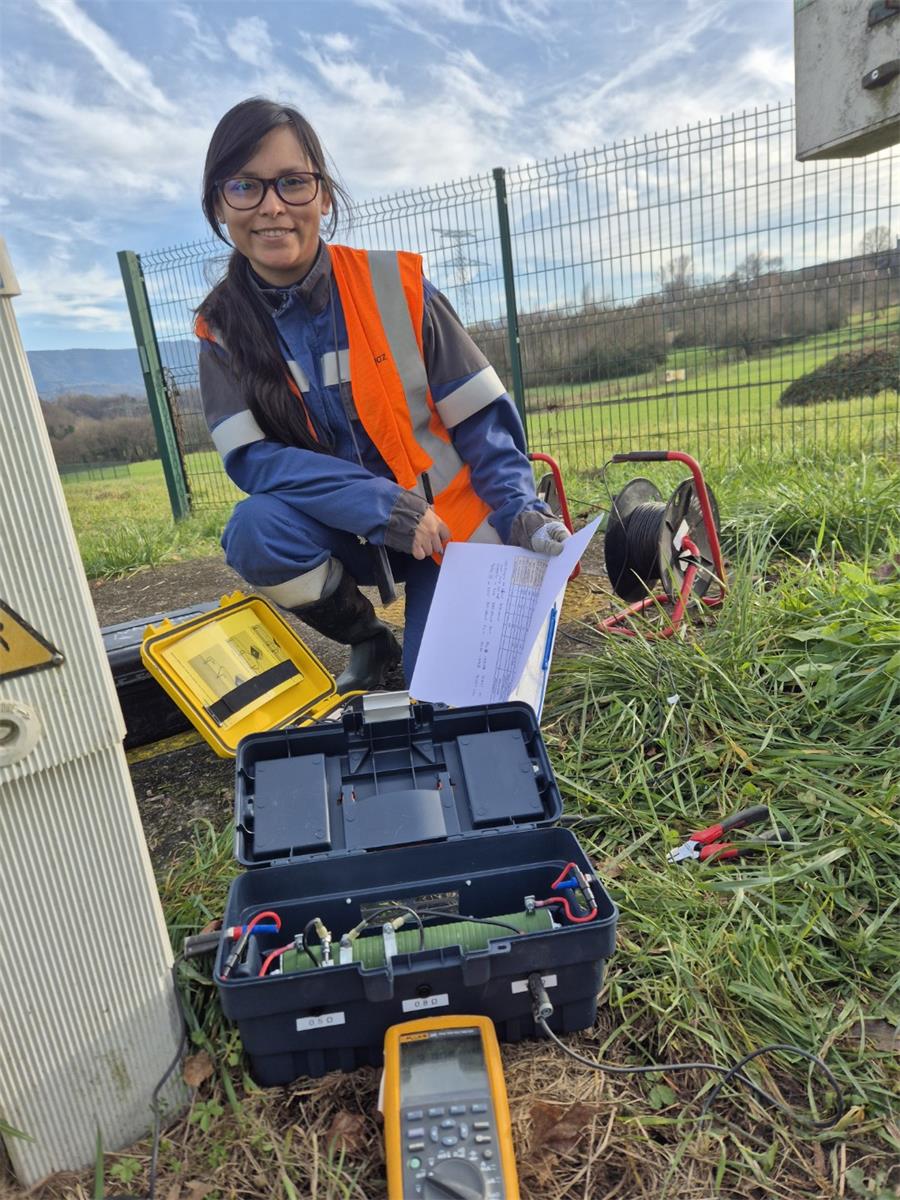
By Paola Andrea Postigo Rojas, AMPP Ambassador (This article first appeared on Materials Performance.)
Albert Einstein once stated: “Energy cannot be created or destroyed; it can only be changed from one form to another.” This principle provides an appropriate framework for the theme of this article: reinventing young professionals and students through contributions to education within the corrosion engineering field.
On this occasion, as we approach the International Women in Engineering Day on June 23, this reflection also carries a broader significance. It represents not only a personal journey of reinvention, but a contribution aligned with the collective efforts of women who continue to strengthen and diversify the engineering profession.
Reinvention, in a professional context, is about experiencing a transformation and stepping outside our comfort zone. This relates to the quote; we transform ourselves to improve ourselves with new skills, new experiences, and even new dreams. However, I should emphasize that reinvention is a challenge.
To illustrate this, we can see people achieve their goals; it often looks easy. However, we are only seeing the final result, not the entire process or the sacrifices made to get there. We need to focus on the process because that is exactly where reinvention happens.
This leads to a key question: Why is it necessary to promote reinvention and guide the next generation toward the field of asset integrity and corrosion engineering?
The reality is that corrosion prevention goes beyond technical issues; it guarantees a safe and sustainable industry. In other words, while maintaining the integrity of assets, we also preserve the safety of people. However, throughout my professional experience, I have observed two major challenges: a limited awareness of corrosion-related specializations and a significant gap between industry demand and the availability of qualified professionals.
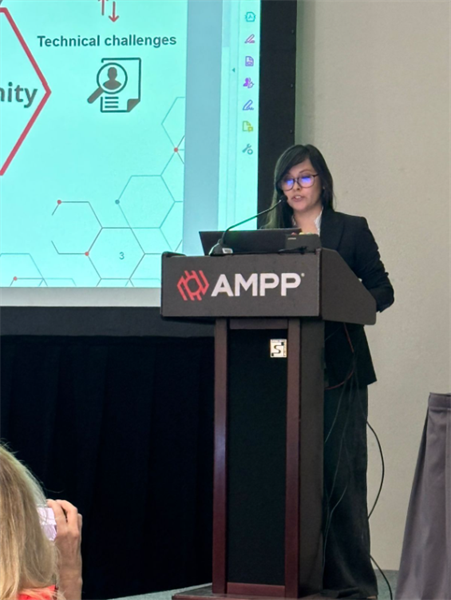
For example, in Bolivia, a country of approximately 11 million people, only around 60 individuals are certified in corrosion-related disciplines. The reason for this is that people are unaware of cathodic protection, coating, or other areas related to the corrosion prevention industry. I experienced this myself during my university years, and it´s a reality I still see today as part of the AMPP Bolivia Chapter.
On the other hand, France, with a population of approximately 68 million, counts around 850 certified professionals in corrosion-related areas. Although this represents a higher ratio, it remains insufficient to meet the growing industrial demand—an issue I directly witnessed during my professional experience there.
Despite these contextual differences, both realities share a common factor: the importance of the human element. This is precisely why we must focus on the reinvention of young people and how they see the corrosion industry. We need to maximize the importance of qualified personnel in the projects and raise awareness within educational centers to make this field more visible.
In this context, the process of professional reinvention can be understood through three key pillars: education, perseverance, and opportunity.
These steps could have a different order depending on the individual's unique circumstances.
Education is often the starting point. I think back to the last year as a petroleum engineering student. During a gas transportation course, my professor briefly mentioned integrity. At the time, it was treated as a minor detail, but it sparked a deep curiosity in me.
That same year, a short cathodic protection (CP) course was offered. It was designed for experienced professionals, not students, but I decided to enroll anyway. Although it was challenging to grasp the concepts without field experience, that initial knowledge became my foundation. It was the key that opened the door to my first job and, eventually, my first certification.
Many of us experience this reinvention during university or our early careers. However, we must advocate for this mindset to begin even earlier in schools and colleges so young people can explore these specialized paths before they even choose a career.

Perseverance is the engine of reinvention. For instance, while my first job in CP was technically enriching, the company did not support my desire for advanced certification. To bridge that gap, I took on small side cathodic protection projects in Bolivia to raise funds for the CP1 course.
I even played the mandolin on the streets in my free time to make some more money. I learned to play the mandolin when I was a child and also studied engineering thanks to my mother’s efforts, as she always supported me and strongly believed in me.
I was finally able to take the CP1 course in Ecuador, since those courses weren't available in Bolivia, and obtained my first certification. It was a milestone moment. But the challenge didn't end there. Moving to France in 2020 required me to learn a new language to integrate professionally during a year when the whole world was forced to reinvent itself.
Today, I continue to challenge myself by working and communicating in English, yet another language I have had to learn along the way. This reflects an ongoing process of reinvention, ensuring that my message can reach a broader audience.
Perseverance is vital because this field is rarely discussed in mainstream society; it requires stepping far outside your comfort zone and constantly learning.
As a woman in engineering, this perseverance also reflects a broader dynamic. Progress in this field is often achieved through consistent effort, competence, and collaboration. Each individual experience contributes, in a meaningful way, to the ongoing presence and recognition of women in technical disciplines—strengthening not only diversity but also excellence within the profession.
Opportunity, the third pillar, is closely linked to preparation. My start in cathodic protection happened because I was prepared when the moment arrived. I noticed a gas pipeline being built near my home in Cochabamba and saw a woman engineer installing a CP system. I simply approached her and asked for a job. She gave me a test: complete a complex potential measurements report. I worked for two days straight to finish it, and that effort secured my position.
Later in France, my previous experience and CP1 certification were key to securing my first role. The company showed great confidence in me, supporting my pursuit of the ISO-equivalent CP3 certification. Studying technical standards in French was daunting, but I succeeded. It was a woman in charge of operations who trusted me enough to enroll me in the training and examination for the CP3 ISO certification.
The point is this: opportunities will arise, but success is a split: 70% is your acquired knowledge and skills, and 30% is the willingness of companies to invest in qualified talent.
No part of this process should be underestimated. By recognizing these steps, we don't just reinvent ourselves; we gain the tools to help reinvent others based on our own experiences.
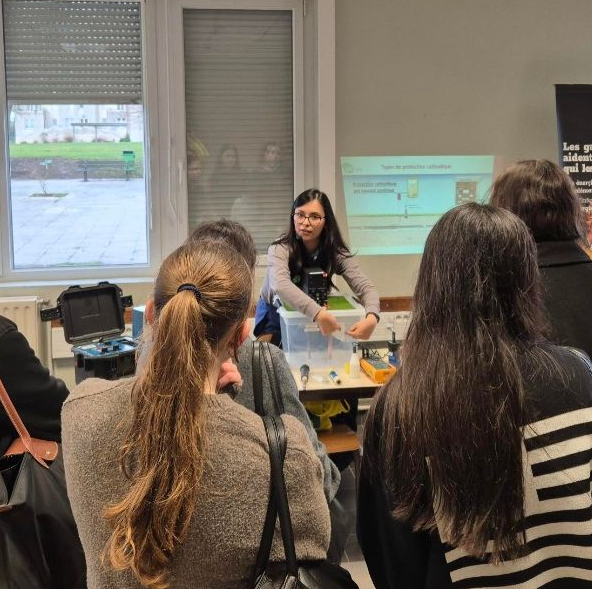
In 2025, with my company’s support, I visited several schools to introduce cathodic protection to 15-year-olds. Most of them had never heard of the field, yet I saw a genuine spark of interest. It was an enriching experience that confirmed my commitment to continue reaching out to schools and colleges.
I also participated in a project dedicated to encouraging young girls to pursue STEM. While many already had their paths chosen, 4 out of the 12 teenagers expressed a new interest in corrosion science. To me, that is significant progress. Currently, I am collaborating with a public institution in Bolivia on a similar project to bring corrosion awareness to the classroom in Spanish and in Quechua.
My message is simple: we must talk about these technical specialties in schools as naturally as we discuss medicine or law. Preventing corrosion isn't just a technical task; it benefits society by making assets last longer, driving industry sustainability, and most importantly, ensuring public safety. By engaging students earlier, we do not just raise awareness; we build a pipeline of highly qualified personnel for the future.
Let us bring the conversation about coatings, cathodic protection, and pipeline integrity into our schools and colleges, while continuing our work with universities and technical institutes. One of my next projects is to create 'technical stories' to make learning fun for children, a goal I believe we can all contribute to.
On this International Women in Engineering Day, I wanted to share my personal experience and give a clear message: fostering awareness, supporting education, and encouraging continuous reinvention are essential steps toward building a stronger, more inclusive engineering community. The contribution of women in engineering is not defined by distinction alone, but by the quality of their work, their resilience, and their commitment to advancing the field for future generations.
As I often reflect: “Every day I reinvent myself by reinventing professionals and inspiring the professionals of tomorrow.”
For more on AMPP’s celebration of International Women in Engineering Day 2026, click here.
Photos courtesy of Paola Andrea Postigo Rojas.